In Tower Tactics II you don’t pick towers from a menu. They come out of your hand of cards. Every turret, every tile upgrade and every spell is a card in your deck, and the deck is your whole defense. It’s a brilliant idea for mixing two genres, and it works. My only real complaint is balance: one of the two heroes I played kept leaking the first wave, and the other could barely lose.
The setup is light. You’re protecting a tavern in space from the Sal’koth, working your way across a randomly generated map, and building your deck as you go. Stack turrets if you want to hold a line, or lean on spells for a more hands-on build. This is the sequel to Tower Tactics: Liberation from asraworks, and it went into Early Access on Steam on 8 October 2026. I played a pre-launch build for about three hours.
Four cards, three mana
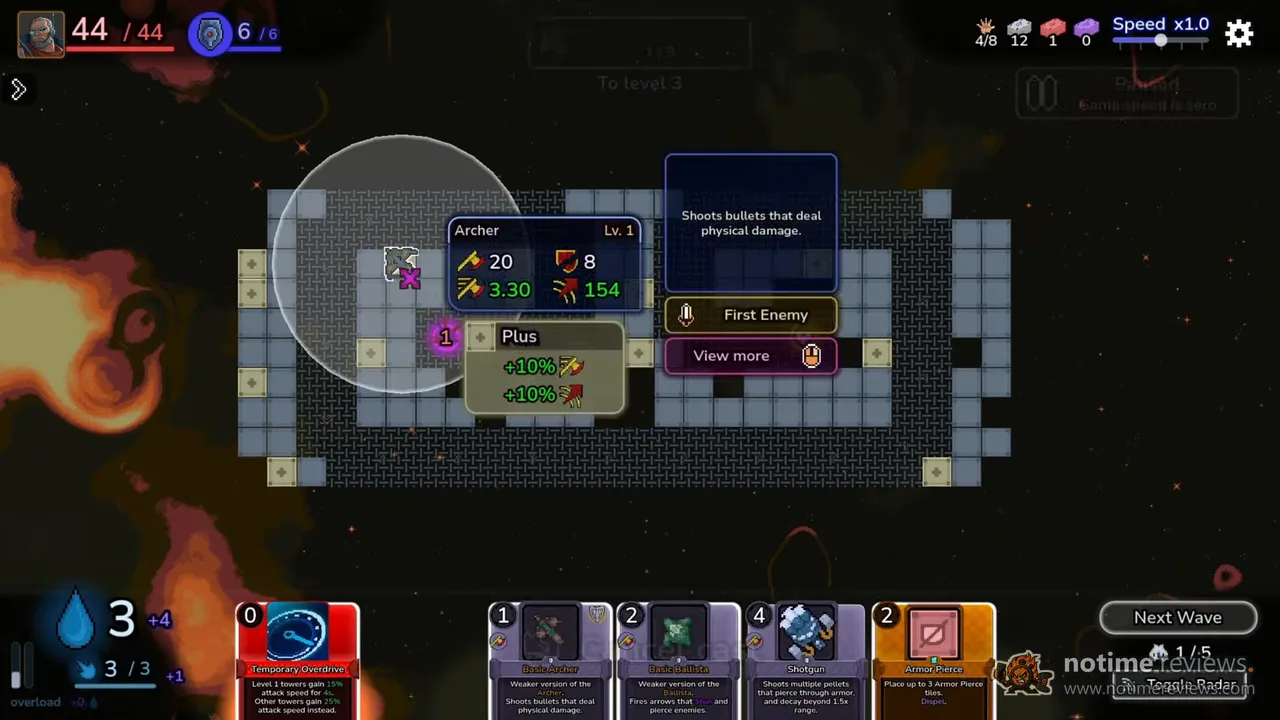
Each fight is classic tower defense. Waves march toward your core, and every enemy that gets through takes a bite out of your health. What changes is where your defense comes from.
You start a fight with 4 cards in hand and 3 mana crystals. Most cards cost 1 to 3. Rare ones can cost 9 or 10, which sounds exciting until you notice none of them are in the starter deck - you have to earn them. The opening turns run on cheap archers, ballistas and bombers.
Win, and you earn crystals and pick one of three new cards: a copy of something you already own, a better version of it, or something new. Whatever you take goes straight into the deck for the rest of the run. By the end, the deck is a record of every fight you won and every choice you made along the way. At no point did the tower defense and the deckbuilding feel like two games stitched together, which is the hard part of a mix like this.
Between you and the boss
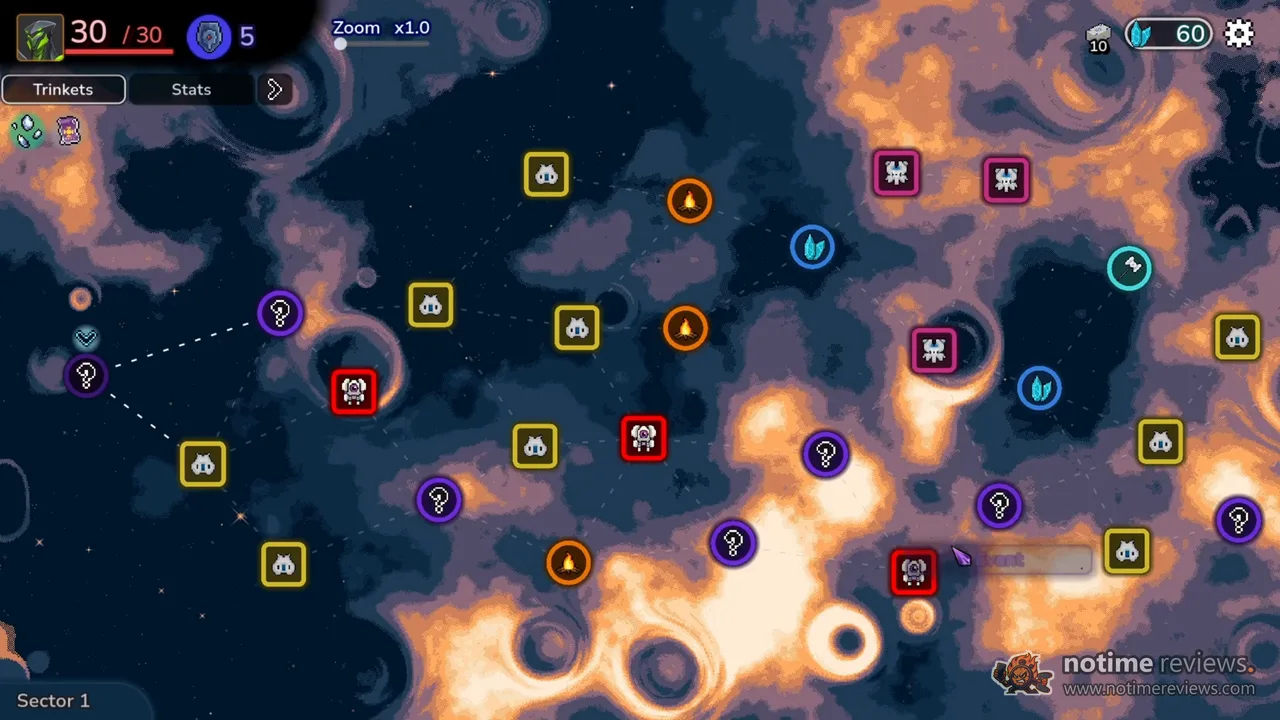
Fights aren’t the only stop on the map. Every mission runs across several stages, each one ending in a boss, and the route to that boss is randomly generated. Events hand you two or three choices that pay out in cards, a fight or trinkets. Special battles bend the rules with endurance fights and labyrinth builders. Need a breather? There’s a rest stop to heal or upgrade, a shop for cards and trinkets, and a forge for card upgrades. The crystals from each fight go right back into the deck for that run.
Finish the run or die trying, your character still gains experience, with stats and new cards on level-ups. New map, new paths, new hands. None of my runs felt the same, and that’s where the replay value comes from. The Steam page lists 190+ cards and 150 trinkets, so there’s plenty of room to experiment with builds.
How far those builds got me, though, depended almost entirely on the hero.
Tower Tactics II screenshots
The Weaver leaks, the Warlord coasts
Each hero comes with their own cards and playstyle. In the build I played, only 2 of the 5 heroes were unlocked, and two was enough to find the one thing that felt off.
The Weaver’s starter deck holds exactly one damage turret. Everything else is a debuff turret that deals little or no damage. With the Weaver, almost every first wave slipped through, because I didn’t have the damage to take down even one monster. Maybe the RNG had it out for me and every opening hand just happened to have one damaging turret in it. It still felt weird.
The Warlord is the opposite. Early on, his kit is so good that it’s fairly hard to lose.
So which one is the problem? Is the Warlord overpowered, or is the early difficulty simply too low? I assume the difficulty ramps up later in a run. But three hours in, I can’t tell you which it is.
The idle mode I couldn’t leave
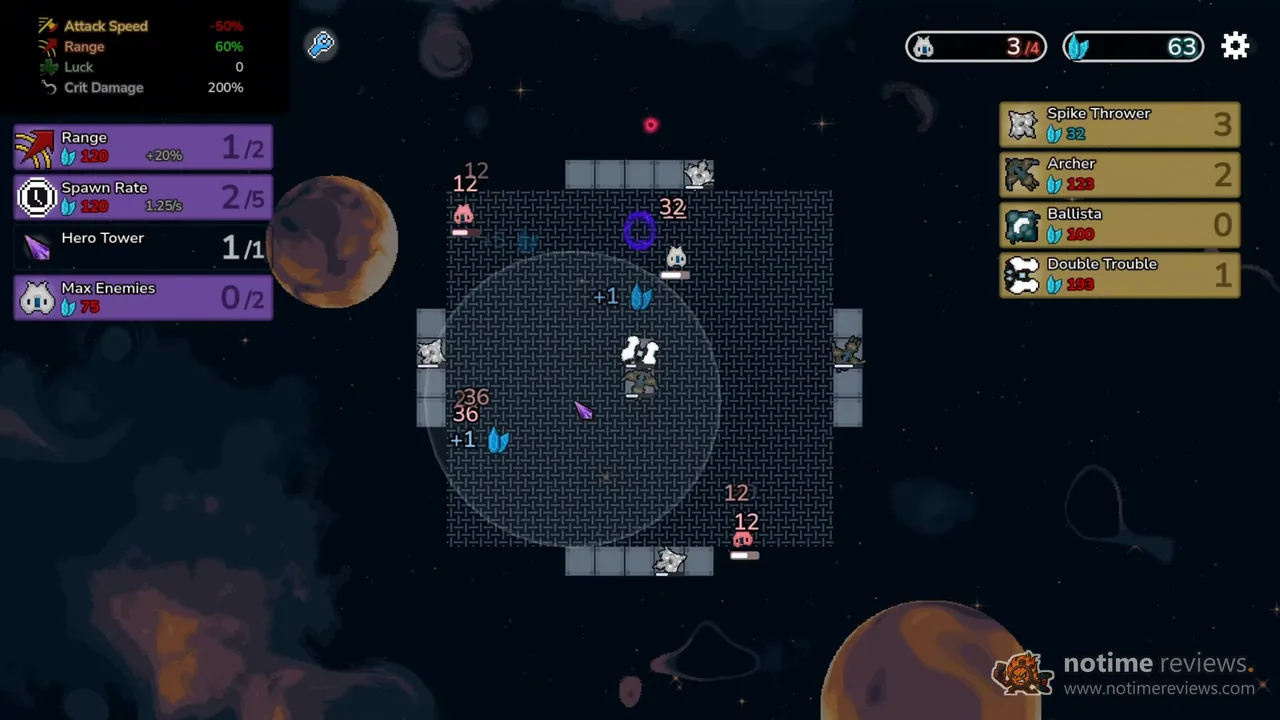
The campaign isn’t the only way to play. A couple of the extra modes were open in my build, and one of them is an idle crystal farm: your turrets shoot at enemies that never stop spawning, and the crystals keep stacking up while you spend them on range, spawn rate and more turrets. I don’t want to admit how long I spent in there. It’s perfect for zoning out, and if you’ve ever left your turrets running just to watch numbers go up, you’ll get it.
A lot was still locked in that build. Most of the between-run upgrades were switched off along with three of the heroes. Steam now lists Survival, Maze Builder, Sandbox and Crystal Mines on top of the campaign, and I’m curious to see what Early Access opens up.
Who should play it
If you like tower defense and you like deckbuilders, play it. The genre mix is brilliant, the implementation is flawless, and random maps plus card draws give it a lot of replay value. Everything from the core loop to the mechanics is top notch.
The difficulty is the one thing that feels off. If you start with the Weaver and the first waves keep getting through, it might not be you. If you start with the Warlord and nothing seems able to touch you, it might not be you either.
When one strategy leaves everything else behind, should the developer nerf it or raise the difficulty around it? Orc Incremental isn’t a deckbuilder, but it runs into a similar question, and our Orc Incremental review digs into it.